
Strategic Lethargy
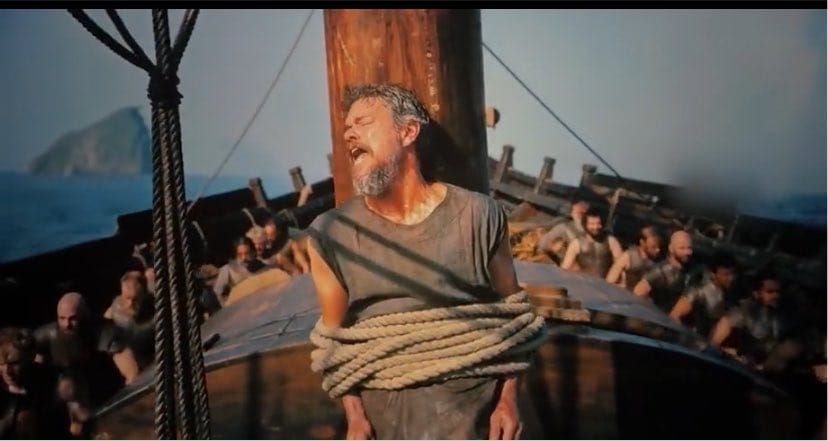
In his 1990 letter to Berkshire shareholders, Warren Buffett let slip the least heroic sentence ever written about making money:
“Lethargy bordering on sloth remains the cornerstone of our investment style.”
Lethargy. Sloth. From the man who has compounded capital at roughly 20% a year for six decades, the cornerstone turns out to be not hustle, not an information edge, not conviction under fire, but the willingness to sit still — and it reads like a joke until you realise he means it literally, and that the discipline of doing nothing is the single hardest and most profitable skill an investor can learn.
From childhood we are taught that good things come from action, that effort and reward are joined at the hip, that the diligent get on and the idle get left behind, and for almost everything in life this is simply true — which is exactly why investing catches us out.
Investing is a game unlike any other
Investing quietly breaks the link between effort and outcome. In most endeavours you are the one doing the work and the result follows from what you do; in investing you are a passenger, betting on a business you do not run, whose fortunes turn on decisions taken by people you will never meet. It is a derivative game — your job is not to build the company but to pick it and then to sit on your hands while it does the building — and the reflexes that serve you everywhere else in life, the bias for action and the urge to be seen doing something, are precisely the ones that cost you money here.
Liquidity can also be a trap
For most of history, the markets for land, for real estate, for a stake in a private business or a painting had no ticking price on a screen and no one standing ready to buy from you. This illiquidity forced a certain seriousness on the buyer — with no exit on demand, you had to actually understand what you owned and what it was worth, or lose your capital. Then came the stock exchange, and with it the great convenience of capitalism: a marketplace where a market-maker will quote you a price on a listed business at any moment of any day. Daily liquidity meant anyone could buy this morning and sell tomorrow without ever forming a view on the company or the industry behind the ticker, and so the attention drifted, quietly and permanently, from the business to the price.
In 2023, Indians bought more than 85 billion options contracts — nearly eight times the American volume — and held them, on average, for under half an hour.
Half an hour. That is not investing in any sense; it is outright speculation.
Patience does pay
The case for sitting still is not sentimental, it is arithmetic — the longer the holding period, the smaller the chance of losing money, because time lets a good business’s compounding overwhelm the market’s short-term moods. The chart below shows it plainly: stretch the holding period out and the probability of a negative return falls away.
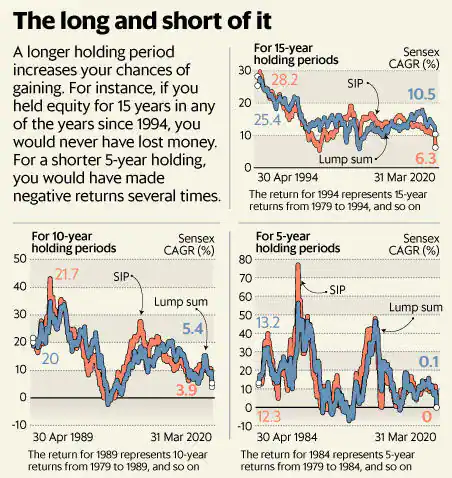
The long-term investor’s edge is not intelligence or information; it is the willingness to hold when everyone around him is selling, and to sit on his hands when everyone is buying.
How do we resist the sirens?
Which brings us to the oldest description of the problem, some three thousand years old and, as it happens, back on the big screen this year. In Homer’s Odyssey, Ulysses must sail past the Sirens, whose song is so beautiful that every sailor who hears it steers onto the rocks trying to reach them. Knowing that willpower alone will not save him, he has his crew fill their ears with wax and lash him to the mast, so that he can hear the whole song and still not act on it.
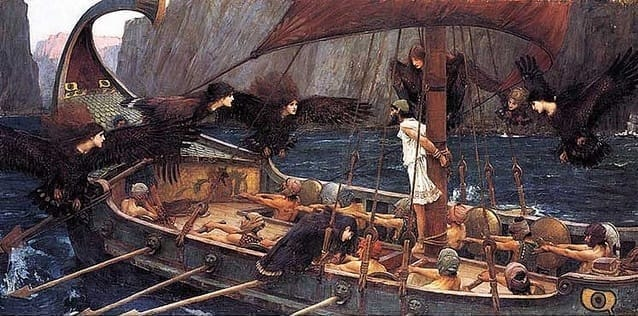
The daily stock quote is the siren song of our age — beautiful, insistent, and fatal to the sailor who turns toward it. The successful long-term investor is Ulysses at the mast: he uses the liquidity of the public market to buy, and then binds himself to it, choosing to treat what he owns as if it were private and unquoted, deaf to the price even as it screams up and down.
What about when the stock moves a lot?
The song is loudest at the extremes. When a stock doubles, the pull to act becomes almost physical — to book the gain, to be sensible, to lock in a winner — and so we clip our compounders one sale at a time and wonder later why we never seem to own the big one all the way up. The right response to a stock that has run, as long as the business is doing what we bought it to do, is the same as the response to a stock that has fallen: nothing. I was reading Lindsell Train’s annual letter recently and found the discipline put about as well as it can be:
“Quick fixes can hamstring the long-term compounding we seek, and our preference when in doubt is to resist the temptation to act… Exiting early from a long-term compounder has structural consequences and, where possible, we will spend days, months, or even years, assessing the severity of a problem.”
The phrase I have used ever since — strategic lethargy — I owe to Guy Thomas’s Free Capital, and it stuck to me like few others because it names the thing exactly: not the absence of work, but the deliberate choice not to act while the work you already did keeps paying off.
So what should investors do?
Nothing, mostly, and this is harder than it sounds because inactivity feels like negligence when it is in fact the strategy. Unless you manage money for a living there is no reason to trade at all; the real work is quiet and unglamorous — reading the annual report, sitting through the quarterly call, watching for genuine deterioration in the businesses you own and for better ones going cheap and unnoticed elsewhere.
If the conviction holds, a falling price is not a reason to sell, it is only the siren, testing whether you are still tied to the mast.
So, in the most literal terms: turn off the business channel, delete the portfolio app from your phone, and if you really want to help your returns, go on holiday.
Jim Rogers, who made his fortune and then spent years driving around the world, said it best:
“One of the best rules anybody can learn about investing is to do nothing, absolutely nothing, unless there is something to do.”
— Jim Rogers
Member discussion